
An ode to your human complexity
and a pep talk to show you it belongs online

Welcome to the Lighthouse Library! I broke up with content marketing, and I explore ways we can show up online that honor who we are as humans and professionals. I might be a content professional, but you’ll find no niching, no Substack growth talk, no marketing tactics here.
My multilingual identity has influenced my writing in big ways. In this piece, I share how my own languages and cultures have shaped my work and why I want to help other multilingual writers/creators.
Hello reader,
I’ve noticed a pattern in the clients I’ve worked with recently: All of them use multiple languages in their work.
Funnily enough, that is also the case of most of my network, friends, and, well, my very own family. It’s not uncommon for us to use 4 languages at the dinner table! Swedish words are mostly courtesy of our toddler, who brings them home from daycare. English we use with friends who don’t speak French or Spanish (and in Paddington books); Spanish is our go-to language and my husband’s native tongue. As for my native French, I use it mostly when I’m alone with our daughter.
Perhaps it’s not that surprising. When I was a teenager, I spent Saturday afternoons translating my favorite bachata songs to French and learning English slang with Lily Allen’s Alright, Still album. That was my version of fun, and a budding passion that marked the beginning of my journey through the layers of language, culture, and identity.
My lifelong journey through multilingualism
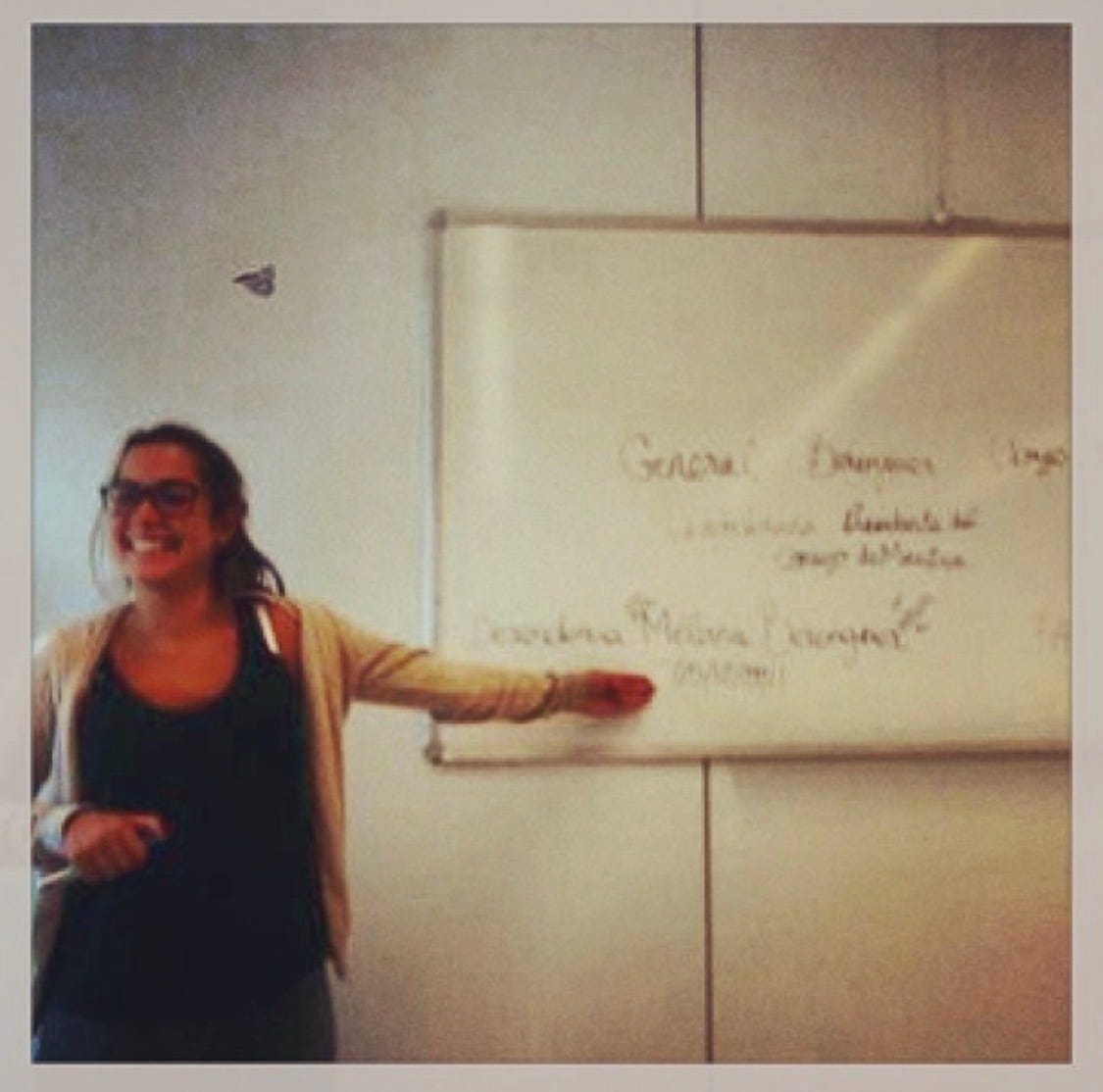
I studied translation after all, and that Ely in the photo above also worked at the Museum of the European Parliament in Brussels. I was surrounded by people with the richest, most diverse multicultural and multilingual backgrounds, where identity, language, and creativity were often the topic of conversation in the break room.
I once ran a blog where I wrote in three languages – English, French, and Spanish – where I blended storytelling and opinion writing about multilingualism. Backpacking through New Zealand in 2015, I even received compliments from natives that I wrote better than they could.
I’m not one to brag, but that was a proud cookie moment, especially since, like many non-native speakers, I’d been insecure about my non-nativeness for years, despite my fluency.
The following year, sitting in an English as a lingua franca course during my linguistics master’s, I learned that 80% of English speakers are non-natives. That was when my insecurity slowly evaporated (and why yes, I’m most definitely considering writing an essay about English as a lingua franca).
I’ve also lived my entire adult life “abroad,” getting to know cultures as far removed from my own (China), and others that I wear like a second skin now (Argentina). These experiences have taught me to put myself in other people’s shoes, to aspire to assume the best of others. After all, there is no such thing as a “stupid” question when not knowing is to be expected.

Multiple languages = multiple identities
It’s no wonder my clients follow similar life paths, where languages and cultures have shaped their identities in multiple ways. Their “native” identity might feel like a box they don’t feel comfortable in, or simply don’t want to stay in. I feel it too, this pull to wriggle out, to caveat every part of me.
I get that labels get old and tired after a while – I am French, but only my passport and my high standards for bread and cheese say so. The rest of me is a blend of everything and everyone I’ve known along the way. I don’t like to be labeled “French” when that is the least interesting thing about me.
I also understand the occasional challenges of showing up online in a language you will forever be “non native” in; of not quite fitting in a culture or linguistic environment where people assume who you are based on your accent or the language you speak. I understand what it feels like to be the “outsider,” even in spaces where you supposedly belong.
I understand the nuances of existing in multiple languages, multiple cultures. With each one, we step into different versions of who we are. We get to create identities that are unique to us.
Why should this be different in our working lives?
Why should we limit ourselves to one part of us because it’s going to make our thoughts more “marketable?”
The wobbles: Non-nativeness and hitting the publish button
I also know that being a non-native and living at the crossroads of culture comes with a dose of confidence wobbles and questioning. Am I pronouncing this word correctly? Should I use this or that word? What will people think of my accent?
These wobbles are very similar to the pre-hitting-the-publish-button wobbles. My opinion on identity labels and marketing niches is the same: They only go so far. They divide us. They discard the complexity of the human experience. We are multidimensional humans in the way we speak; we are complex humans in the way we work and communicate about it.
My perspective on crafting digital content is influenced by all of this. That’s why I put a strong emphasis on discovering and using your unique experience, opinions, and perspective in your communication. Your newsletter, your pitches, your social media posts… They are not boxes you need to fit into. They are containers you get to shape with who you are.
There is no one like me; there is no one like you. Your humanity makes finding a niche irrelevant – and that is liberating.
In a world that wants simple, straightforward, bland…choosing to be yourself is one of the hardest, yet most rewarding things you can do. I’ve said it before, and I’ll repeat it again and again for as long as I can: Choosing complexity, choosing depth, choosing substance – that is an act of resistance. Use your wonderful brain, your wonderful identities, do not simplify who you are because it’s more “marketable.”
Cheers to bringing all of you into your work and your writing.
Cheering you on!
Ely
Are you a multilingual speaker? How has that influenced your work?
This piece was edited by Jordan Parker.
Keep reading
Okay, but HOW do I bring all of myself into my work communication? No, you do not need to post selfies on LinkedIn or write unhinged Substack Notes. I wrote about the framework I use to structure my own communication and with my clients here:
Moving away from "creating content" towards meaningful communication

Last November, I wrote Breaking up with content marketing, where I explained why content marketing principles have limitations for small business owners and service providers. I was especially vocal about the fallacy of the niche. In this essay, I dive deeper into why communication in a loud digital landscape can seem pointless, and I present the journa…
It’s a long one, so grab a cup of tea (or mate <3) and get cozy for a long read. You’ll be hearing about this framework a lot in the coming months. The essay even includes a special interview with writer & strategist Laura Vegh, who shares a helpful perspective on what makes “good” content and why AI can never make “good enough” content.
Stick around for more


Hi, I’m Ely (reads like Ellie). I help small business owners write and publish long-form digital content like essays, articles, and resource libraries. I use a journalistic approach to content creation, anchored in opinion writing and the concept of angle. If that sounds like something you want to explore, check out my flagship service.
Another beautiful post and a permission to show up fully as ourselves. In this world full of AI slop and templates, this is so refreshing! Thank you Ely! Danke!🙏