
Say bye to the niche for good: Use this framework to bring creativity and structure into your writing instead!
Introducing the journalistic framework I created and use instead of a niche + special interview with writer and strategist Laura Vegh on what makes good content.

Last November, I wrote Breaking up with content marketing, where I explained why content marketing principles have limitations for small business owners and service providers. I was especially vocal about the fallacy of the niche. In this essay, I dive deeper into why communication in a loud digital landscape can seem pointless, and I present the journalistic lens I apply in my work as a communication strategist and digital publishing consultant instead. If you have opinions and stories to share – this essay is for you!
Surprise: This also includes an interview with Laura Vegh, writer and strategist, about “good” content. It’s the first interview for a new section called “Against the Feed” that I’m proud to introduce!
Gentle invitation: This is my longest Substack piece to date (no less than 3,400+ words, and then some for the interview), so grab a cup of tea and get cozy for a long read!
A few years ago, right before the pandemic hit, I caught up with a friend in Paris. It’s one of those relationships where you meet once every five years, and straight away, the conversation goes into the deepest seas of our thoughts. He told me, “I don’t think I want to search for happiness anymore, I want meaning more.”
It hit me hard: I was coming to grips with the scope of the climate crisis – its impact on humans and our role within it. I was starting to look at the other side of the coin called capitalism, and seeing growth as a problematic obsession rather than a promise to aspire to fulfill.

In my head, capitalism and happiness were linked: Capitalism says we can be prosperous by aspiring for more. More money, more work, more followers, more things. While my version of happiness often involves quiet time, books, and cozy conversations, I grew up in this world, and I am not immune to its deep-rooted narratives. Dipping my toes into climate science, the role that economic growth has played in the destruction of our ecosystems, and the ugly power dynamics behind it, one thing became crystal clear. More has increasingly meant more heat waves and droughts – clear dangers for human health, including our food supply and safety. More does not equal happiness; in fact, it has hindered and destroyed it.
The months following that conversation about meaning, my thoughts reached boiling point.
I was living in Shanghai then, so we went into lockdown at the end of January 2020. With China’s state-run firewall, which increased its cybersecurity around that time, our VPN was unreliable at best. That meant Instagram, YouTube, and even my Google Drive and Gmail got harder to access. Both work and play took a hit.
I was left with my crafts and books, and time aplenty to look out the window.
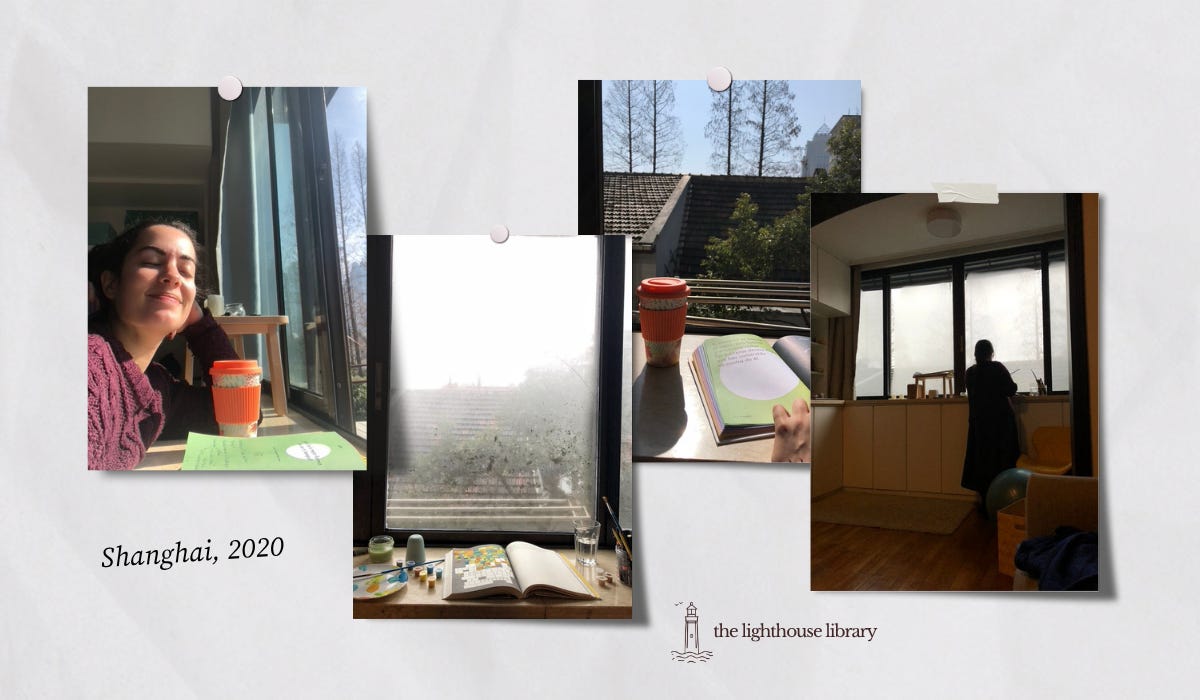
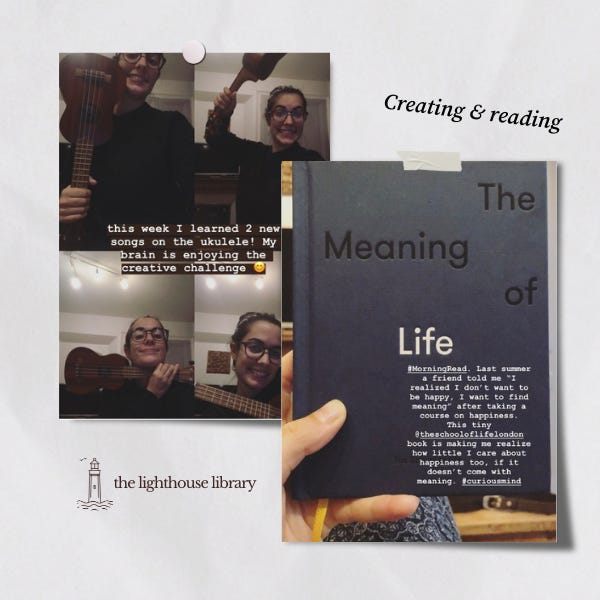
I used my newfound brain space for deep reading. I learned about basic biomechanics and the impact of our sedentary lives on our bodies with Katy Bowman’s Move Your DNA. With Cal Newport’s Digital Minimalism (fitting), I re-assessed my relationship with my screens and social media. And, finally, with The Meaning of Life from the School of Life, I sat thinking about all the things, big and small, that made my life meaningful.
Slowly, my grip on wanting happiness shifted. I started pondering what a “good” life means, and as my life has shifted over the years, the answer has evolved with it.
Since last summer, around the time this Lighthouse Library publication was born, that question started inhabiting my work thoughts, too: What does “good” work mean? What is “meaningful” work?
In my line of work as a digital publishing consultant, I talk to people about their communication hurdles. I often ask: “What does good communication look like for you?” and “If nothing changed about the ways you communicate about your work today, what impact would it have on your work and business?”
More importantly, I listen for what answers this question: What does meaningful communication look like?
And let me tell you: I have yet to hear someone say they want “X subscribers on Substack” or “X followers on LinkedIn.” Growth alone is not meaningful.
So, what does meaningful communication look like?
Let’s dive in by first looking at “good” communication. We can start, as my linguist heart likes to, with the definition of “communication.” Going back to the roots of a word brings us back to its essence and blocks out the noise. Then, we’ll look back at that late-capitalism perspective.
The roots and essence of communication:
It comes from Latin, communis, which initially meant “public, common, general.” It then became communicare, which meant “to share, impart, make common.” The essence of communication lies in the sharing and transmission.
Communication, according to the Cambridge dictionary, is the act of sharing information with others through speaking, writing, moving your body, or other signals. Here again, sharing is the core of the meaning of communication.
Good communication, in that way, should do what it says on the tin: Deliver a message the way we intend it to land and to the person or people we intend it to get to.
But…it’s not that simple.
Living in a digital-first society means a lot of our communication happens over the internet. As a result, we don’t communicate only with the people around us anymore. We are talking to bigger crowds, yes, but so are others across oceans. We exist in a busy and loud digital landscape, and if that place were a country, it’d be a chaotic technocracy. It is both liberating and alienating: Our message can travel far and wide, but it can also be buried in the sea of voices we’d never hear otherwise.
And then there’s virality. Behind every viral essay lies good writing, yes. But societal timing plays a big part, as does an influencer or two resharing it, and divine algorithmic intervention. The point is, you could be writing five wonderful essays, and yet only one gets “picked up and carried” by the online world.

Good, or better yet, effective communication suddenly becomes much more difficult to achieve. We haven’t even mentioned the powers at play behind effective communication yet. First, there’s the person who holds the mic. In the words of Virginia Woolf, “With the exception of the fog [men] seem to control everything.” Then, there’s who holds the money. Today, behind a New York Bestseller lies a hefty check spent on marketing to get it there.
There’s also race, skin color, religious affiliation, education, and hundreds of other layers of privilege (and lack thereof) that contribute to effective communication.
You can see that anyone who attempts to communicate, as defined in the first point above, in this busy digital world has defied the proverbial laws of power gravity. So much is out of our control.
YouTuber Hannah Witton had a video go viral on Instagram (48.6M views), TikTok (2M views). In this video, she shares what happened afterwards. In her words: “Spoiler alert: F*** all!”
Within that context, it is easy to feel disheartened and write off our content as pointless. The chances of the “right” people seeing it feel less up to us than the “powers at be.”
Add to that a sense that because you have things to say, are good at what you do, and intend to communicate that, you “should” be good at communicating it. Suddenly what should feel inspiring and meaningful – expressing your ideas and talking about your work with the outside world – feels more akin to pushing a boulder uphill.
How do we post and publish consistently in these conditions?
Shifting from content marketing to a journalistic viewpoint
Content marketing advice will give you this: Pick a niche, stick to it. Be consistent, nurture your list. I won’t go into why I think this has its limitations; you can read about it here.
I’d like to offer my alternative: A shift from “good” communication to meaningful communication.
I cannot promise virality or assure you a growing client base (neither do I want to), but I can promise you this: There’s no niching involved, no writing killer headlines, no having to nurture your list or create endless client avatars. The other path for us to explore is one that will make you excited to post and sustain your body of work, whatever platform it happens to be on.
Using a journalistic lens to ideate, write, edit, and publish – in a nutshell
I’m hesitant to call what I’m about to present a framework, because that word has been tainted by hustle culture for me. Essentially, though, this is a four-part Editorial Line framework that I built from my experience as an Editorial Director at a digital magazine. It also stems from my frustration working with content over the years and trying to fit everything into “content pillars” and “themes” and other boxes.
This is an ideas-led way of building a body of work, which means the driving force behind it is conveying opinions, i.e., ways of thinking and seeing your work, through a unique lens.
What makes a magazine – or a Substack publication – different from a blog section of a company’s website is that its product is the written work. Showcasing specific ideas, concepts, or information through a particular angle is the purpose – not the other way around. With this framework, I want to give you the tools to create a digital library that meets your multiple goals and needs.
Having an Editorial Line is essential to crafting a publication that makes sense for you both as a business owner and a human being.
This is where we begin. Let’s dive in!
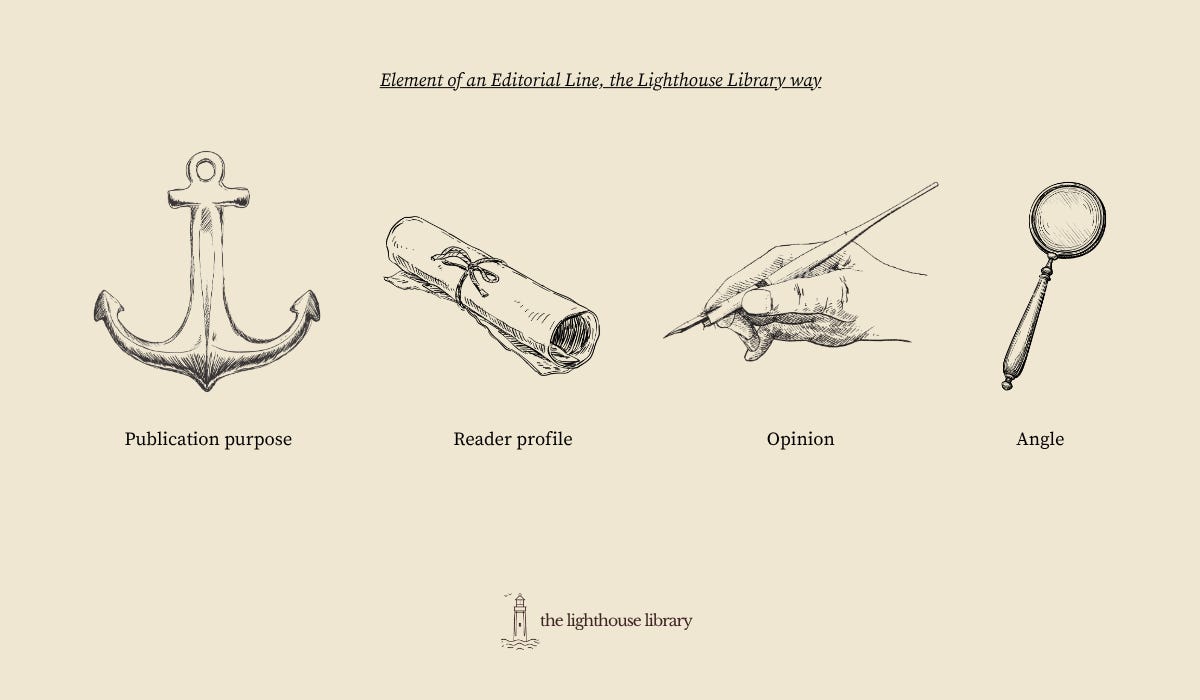
1. Publication purpose - your big why
Content marketing focuses on, well, marketing and selling. Lead generation and moving potential clients down the marketing funnel are the goals: We want our audience to buy from the stuff they read about us. This is honorable, yet as I said, it has limitations.
As professionals, we do not only write to market and sell. If we did, we would not run our own businesses or freelance; we would work at sales or marketing departments of companies instead. Here, my assumption is that you like your work and craft.
So, if we want to keep our communication efforts running in the long term rather than feeling like a drag, our posting and publishing goals should be in line with our creative, business, and professional goals.
This is where your publication purpose comes in. It’s your “why” – the reason this publication exists and will continue to exist in the long run. A publication purpose established “the Lighthouse Library way” looks at what the publication does:
For your business – the reason you can justify the time investment,
For yourself as a professional – the ways publishing helps you grow and create new work opportunities,
For yourself as a human – the needs that publishing helps you meet, such as creating a sense of community or self-expression,
Its role in your broader life – e.g. the impact you want to make in the world, your industry, ecosystems, and communities.
2. Reader profile - who you want to enter conversations with
Here we move away from client avatar to create a broader and more generous picture of who you talk to. Think of it as your “primary reader” rather than your “target audience.” We always want to assume the best of the reader and talk to them as humans capable of critical thinking, growth, and learning, and your reader profile reflects that. It answers questions like:
Who you write for, but more specifically, what patterns you see in the challenges and dreams they have,
The overlap between them and your clients,
Their reading and learning style, how they might interact with and integrate the ideas, concepts, and stories you share,
Their place in your industry, how they relate to it, or their frustrations with it.
To give you an example, my reader profile is someone who enjoys or is used to introspection, who likes writing as a communication medium and may or may not call themselves a writer. They are frustrated with content marketing and social media tropes, but they have things to say and are showing up anyway. It’s also someone who might feel the push and pull of “I need to find a niche” and “I don’t want to be put into a box.”
They might be a future or existing client, but they might be a collaborator – someone who also talks about writing, publishing, and building a body of work; or someone who approaches their work and life in a similar way to mine (e.g., where collaboration is a key value).
There’s a lot more to this, but can you notice that I’ve not mentioned job title or any other kind of demographic? That is an intentional decision – our readers’ experience and human psyche is more relevant to us than where they live or their job title.
3. Opinion - what you say about your themes and topics
Crafting strong opinions and storytelling is the crux of my work as an editor and publishing consultant. We move away from content pillars and topics to ask bigger questions: What do you have to say about your themes and topics, and why does it matter that you say it?
Beyond topics, themes, or a niche, your opinion could be compared to a journalistic beat. It’s what makes your publication distinctively yours, even when you may be writing about the same topics as others.
It is composed of two main elements:
What you address – the recurring tension(s) about a specific topic or theme
Why – the reason it’s important that you voice your opinion and the vision you have for your work (its wider role in the world/society/your ecosystem).
It is common to find a strong link between a writer’s experience or their lifelong passions and why they write about specific topics.
Here again, I’ll use my publication as an example: Some of my themes are building a body of work, communication for small business owners, long-form writing and editing, and creative thinking. But what I address specifically is this core tension: There is a gap between how humans naturally write, create, think, work, and how we need to communicate about it all in a world that is governed by “foolproof” formulas, marketing advice, and soulless content strategies. With my work, I intend to help my reader profile bridge that gap by providing a different perspective and practical tools, and modeling building a meaningful body of work online.
It’s important for me to voice this opinion because a) I’ve built a meaningful digital library before, and it got eyes and made an impact on the industry I operated in, and b) many wonderful thinkers and questioners are not publishing great ideas and points of view… yet the world desperately needs them.
4. Angle - the lens you consistently apply
This is my favorite part of the Editorial Line, but also the one I find the most difficult to explain. It is, in my humble opinion, the most unique. I have not seen this perspective anywhere else, yet it’s the tool that helps you bridge the gap between not feeling boxed in by a niche and throwing spaghetti at the wall.
In traditional journalism, an angle is the lens you use to approach a subject. To give you an example, journalist Laura Puttkamer, in her Substack publication Urban Solutions Journal, writes about cities from a climate and solutions journalism perspective. The stories are solutions created or implemented by a city with the goal of reaching the UN’s Sustainability Goal 11, “sustainable cities and communities.” That is the red thread she follows, but she writes about multiple different topics: From indigenous architecture to creating safer cities for all genders, or even empathy-led pieces about listening to rivers. Her angle is unique and distinctively hers, and readers know what to expect from her work.
Applied to our context, i.e., building a digital library as business owners, we need to ask questions to start identifying the patterns. What perspective do we constantly apply in our work? What is a typical way for us to approach a topic or write an article? It can be helpful to ask what our readers or clients say about our approach.
Here again, using my publication as an example, curious introspection is often the way I choose to approach a new piece of writing. That’s even the frame I use for all my Letters from the Lighthouse, a low-stakes format where I put on my curiosity goggles and look at what I’m thinking, feeling, and learning within the context of my work. Using our busy and loud digital landscape is also a key lens I consistently use. I also want my work to be supportive in nature, either in an emotional or practical way. That latter element is often what readers and clients say about my work and writing. These are lenses that I have been using since Day 1, when I started writing newsletters back in 2018.
Rather than a single thing defining you, it is the combination of multiple elements that makes up your unique angle. In practice, these are usually 3-4 elements that can be as creative or as structured as you want them to be. A scholar might use an academic lens to explore the same themes I write about. A business strategist might look at our busy digital landscape, too, but use engineering principles to explain it.
The sky is the limit, here! Or perhaps, your humanity is the limit, which means the limit is as human as you are.
Adopting a long-term view to put this into practice
I’m allergic to quick fixes, and this Editorial Line framework reflects that. Building a body of work is a decades-long (if not lifelong) endeavor; spending months or even years developing and implementing your Editorial Line is really worth the investment. It helps you move away from content creation and into something much deeper, both for you as a creative human being and professional, and your readers.
We can handle big ideas, and we are smart enough to have important conversations. There is space for everyone to be who they are, and there is a way to do it that is not chaotic, overwhelming, uncertain, or limiting. This is the tool I am hoping to help you understand and implement.
Does this sound like something you’d like to implement?
You don’t have to do it alone.
Moving away from creating “good” content towards “meaningful” digital libraries
Let’s go back to our definition. Communication is about imparting or exchanging information. Good communication is context-dependent: The “right” message, the “right” people, the “right” way – that is all subjective. While the algorithm overlords like to make us think we need them to do this, we still have much more power than we think.
Take your power back! Make decisions for yourself. If you’re going to be showing up online, why not do it your way? Why not take a tiny act of resistance and choose the long view rather than hot takes and virality?
Start from where you are, what you know, what you think, and how you think it. The rest will grow from there.
And if you need support, reach out!
Wishing you gentle and happy sailing,
Ely
I’d love to hear from you. Should I turn this into a practical guide or two? A mini workshop? I’d love to create something that’ll help you experimenting and putting this Editorial Line framework into practice.
And how did this piece make you feel? What train of thoughts did it lead you to?
This essay was edited by Jordan Parker.
Surprise! Welcome to Against the Feed, a cozy corner for interviews where we challenge mainstreams ideas about existing online. Here’s the first one with Laura Vegh, writer and strategist, on “good content.”
Laura and I met through The Lab, the online community by Digital Nomad Girls. She writes funny and sharp observations about the world of content and freelancing on LinkedIn and Substack. When she asked the question “How do you know when the writing in front of you is good?” on LinkedIn, I was working on this piece, and I had to reach out to her. Here’s her take on good content.
1. Can you tell me a bit about the expectations that your clients have about content?
I find that a lot depends on their background and their understanding of content. For instance, I’ve had clients who expected a few blog posts to solve all their problems: Put them at the top of the SERPs [Search Engine Results Pages], bring in new leads, increase their conversions, all within just a few weeks.
That is unrealistic. Content can do all of that, but it is unlikely to happen in just a few weeks, and it also can’t do all the heavy lifting alone.
Your blog might land at the top of the SERPs, but conversions also depend on other things like how well-known your brand is, how you present yourself across other channels, and probably the most important part: The product you’re selling. If the product doesn’t respond to the user’s needs, good content won’t help you for long. It might drive some views, leads on the page, and maybe even a few purchases at first, but in the long run, the copy won’t make much of a difference.
I’ve also had clients at the other end of the spectrum, who understand that content is one of many tools. It can and does help when used wisely, but to get the results you want, you need to use it as part of a bigger system, not as a quick fix.
2. In your view, what key elements do you find in “good” content?
For me, good content is easy to read, answers real questions, and feels like it was written by someone who understands the reader. It’s the type that informs or entertains a reader without things like clickbait ideas or fear-mongering. It makes you feel that whoever wrote it has been in your shoes, or just understands you, sees you and whatever problems or questions you have.
Lately, there’s been a lot of discussion around “AI slop.” I feel like it’s almost impossible to talk about good content without mentioning AI, especially since the conversation has taken a ridiculous angle. People on social media, especially on LinkedIn, are saying that if they see an em dash or parallelism, they are certain that it’s AI-generated content and automatically label it as bad. They don’t even bother to read the content anymore.
Don’t get me wrong, this isn’t an ode to AI-generated content. I don’t think AI can get to true good content, but a slight overuse of parallelism or of em dashes isn’t what’s making it bad. AI can inform; it can give you definitions, maybe it can even find accurate statistics and other data and provide a good analysis. But it has never been in the reader’s shoes. It has no true subjectivity, no true experience, and no true empathy. It also can’t have a true opinion. Its answer, even when it labels it as “an opinion,” is nothing but the result of data and pattern analysis.
That’s also why I don’t think the current obsession with “AI tells” makes much sense. The problem is that AI lacks lived experience like humans do – it can’t truly relate, empathize, or take a real stance. That’s the difference you feel as a reader.
“Good content makes you feel like whoever wrote it has been in your shoes. […] [AI] has never been in the reader’s shoes. It has no true subjectivity, no true experience, and no true empathy. It also can’t have a true opinion. Its answer, even when it labels it as “an opinion,” is nothing but the result of data and pattern analysis.”
— Laura Vegh, writer & strategist
3. Does producing “good” content really matter? Why or why not? What else matters?
Yes, good content matters.
When a product, positioning, and the client experience are strong, good content is a way to get closer to your potential customers. Let’s be honest: Most of us are tired of ads. We skip them, block them, or ignore them. Content is different: People choose to engage with it because they’re looking for something. They want to read it.
If the content gives them the information they need, and piques their interest for more, that’s a lead you may be turning into a customer. Not through clickbait tactics, but simply by providing a genuine solution to their problem. Even when the content doesn’t directly sell something but simply informs, if you do that in an engaging way, people start trusting you. They understand you know what you’re talking about and it can be the foundation of a relationship where you give something – relevant information in this case – without asking for anything in return.
To put it into a different perspective, think of fiction. Say you pick up a book by a new author, which so happens to be the first in a series. Maybe you choose it because it’s in the recommended section of your local bookshop, you like the synopsis, or someone recommended it. That book is your first step into that author’s world. If you like it, if it provides the experience you were looking for, you’re likely to buy the next book in the series, even if they don’t tell you “click here for the next part.”
It’s not a perfect comparison, but the principle is the same: If the experience delivers on its promises, people come back.
4. What can “good” content help a professional, a business, or a creative achieve?
It can help get your message across. By that, I mean helping people clearly understand what you do, why it matters, and whether it’s relevant to them. I’ve worked with clients who had great products but struggled to attract the right audience because their content wasn’t strong enough – it didn’t clearly explain what made the product valuable, for whom, or why anyone should care.
Strong content can be a great conversation starter. Take LinkedIn, for instance. The platform is ultra-saturated with content, but a lot of it is repeat ideas; bland posts that are supposed to be “thought leadership” that say nothing and speak to no one.
If you know your audience and find a way to speak to them like a human being, they’ll respond. You might not go viral, but I don’t think that should be the goal unless you’re paid per like, comment, or impressions.
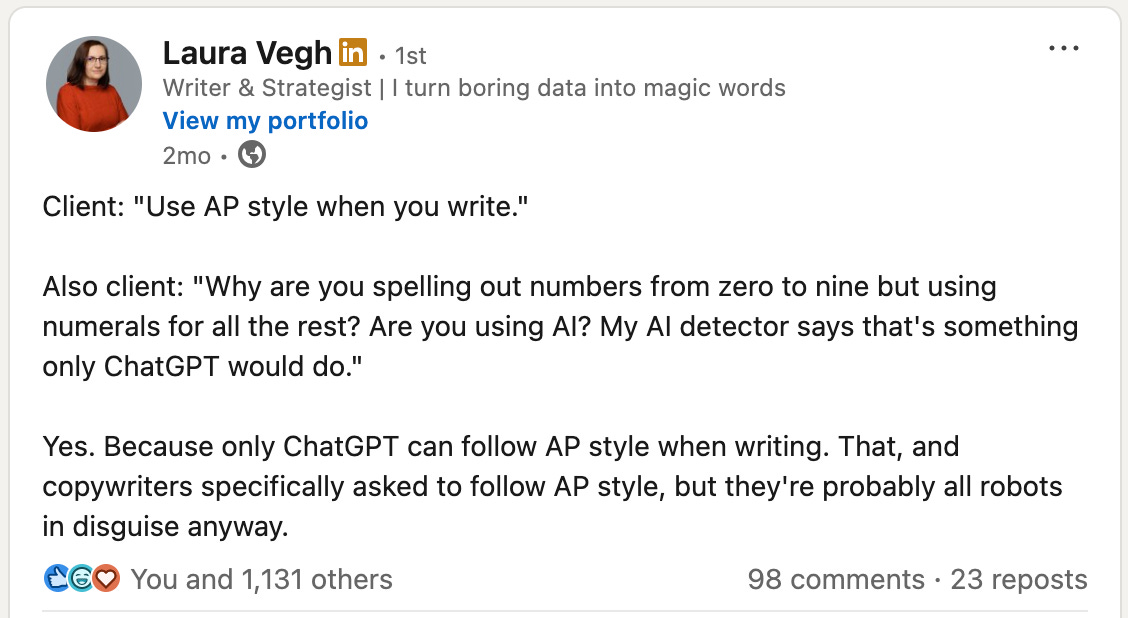
I went viral a few times, and they did increase my followers count, but funnily enough they brought me zero clients. These are usually posts that bring to light either weird trends or client requests, problems almost every freelancer has had in their careers, or just share some jokes. I think people engage with them because they feel seen. That and the fact that they almost always had a bit of humor in them.
Posts that went nearly invisible by social media standards got me a few leads and some turned into clients. These are usually posts that touch on more serious topics, or those where I share a link to my Substack – LinkedIn truly isn’t a fan of that. For instance, a recent post that went nearly invisible (under 150 impressions after almost two weeks), discussed topics around autism. I also had a post discussing clickbaits and fake news. That one stands at under 200 impressions, but it got some interesting conversations going in my DMs.
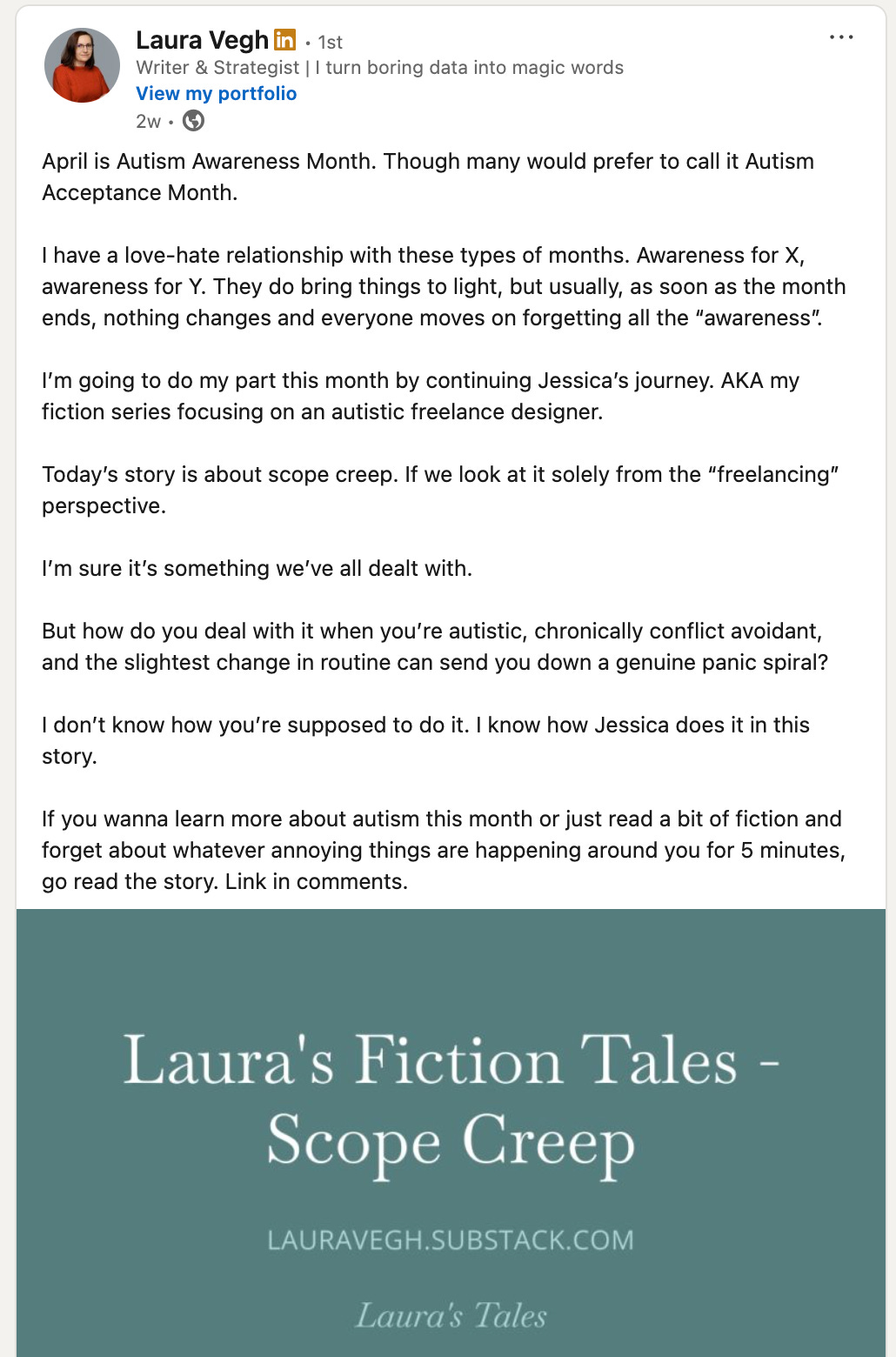
The LinkedIn algorithm certainly plays a huge role here. But I also think audiences, at least my audience, tend to prefer lighter topics, so posts that feel heavier go under the radar for the majority. At the same time, those topics tend to be more relevant to my clients, which is why their impact is something I feel more “behind closed doors,” in my DMs, rather than in the direct engagement.
Both types of posts serve their purpose. Some provide a good laugh and sense of validation for peers in my industry, others bring work opportunities. Ultimately, good content sparks curiosity – about who you are, what you do, and how you think. And that curiosity is often what sparks conversations, leads, and clients.
Connect with Laura
on LinkedIn | Find out more about her work | Read her Tales on Substack (and her latest fiction series about Jessica, a freelance designer who’s autistic)